Can You Register a Car Without Insurance in Texas? (2026 Rules & Penalties)
Table of Contents
- The Short Answer
- How TexasSure Blocks Registration
- Penalties for Driving Unregistered in Texas
- New Texas Residents: 30-Day Rule
- Out-of-State Insurance: Does It Work?
- Workarounds (And Why They Fail)
- How to Fix Your Registration If You Have No Insurance
- Frequently Asked Questions
Can you register a car without insurance in Texas? No — Texas law requires proof of liability insurance to both register and renew vehicle registration. The state uses TexasSure, an electronic verification system, to block uninsured vehicles from receiving plates. If you attempt to register a car without insurance in Texas, your application will be denied at the county tax office.
This guide explains exactly why registration is blocked, what happens if you drive unregistered, and the fastest way to fix your status if you have no insurance.
The Short Answer
Texas Transportation Code § 601.051 requires every vehicle owner to establish financial responsibility before registration. The most common method is carrying liability insurance with minimum limits of 30/60/25:
- $30,000 bodily injury per person
- $60,000 bodily injury per accident
- $25,000 property damage per accident
When you register or renew your vehicle, the county tax office verifies your coverage through TexasSure — a real-time database connecting insurers to the state. If your policy is not active, the system flags your record and registration is denied.
Can you register a car without insurance in Texas? The answer is definitively no. There is no legal exemption, grace period, or temporary registration option for uninsured vehicles.
How TexasSure Blocks Registration
TexasSure is the state’s electronic insurance verification system. It operates silently behind every registration transaction:
- Real-time verification: Insurance companies report policy status to TexasSure weekly. When you visit the county tax office, the clerk checks your VIN against the database instantly.
- Registration lock: If TexasSure shows no active policy, the system prevents plate issuance. You cannot proceed with registration or renewal.
- Law enforcement access: Police officers can also verify coverage through TexasSure during traffic stops, meaning an unregistered vehicle is likely to be flagged immediately.
TexasSure eliminated the old loophole of buying insurance for one month, registering your car, then canceling the policy. Today, any lapse triggers an automatic registration hold.
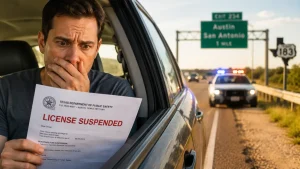
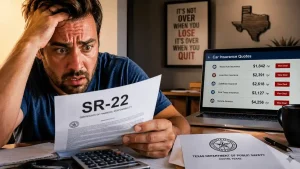
If your registration was denied due to lapsed insurance, your license may also be suspended. You will need SR-22 insurance in Texas to reinstate driving privileges.
Penalties for Driving Unregistered in Texas
Driving without valid registration is a separate offense from driving without insurance. If you are caught with expired or missing registration, the penalties stack:
| Offense | Fine | Additional Penalties |
|---|---|---|
| Driving without valid registration | Up to $200 | Vehicle may be impounded |
| Driving without insurance | $175 – $350 (first offense) | Class C misdemeanor, possible SR-22 requirement |
| Driving with expired registration | $25 – $200 | Varies by county and days expired |
| Both offenses together | Up to $550+ | Multiple citations, court costs, potential impoundment |
Can you register a car without insurance in Texas to avoid these penalties? No — the only way to avoid fines is to obtain insurance before registration. There is no legal shortcut.
New Texas Residents: 30-Day Rule
If you just moved to Texas, you have 30 days to register your vehicle and obtain Texas insurance. During this window:
- Your out-of-state insurance policy must be rewritten to meet Texas minimums
- Your out-of-state registration remains valid temporarily
- After 30 days, driving without Texas registration and insurance becomes a violation
Important: The 30-day grace period does not mean you can drive uninsured. It means you have 30 days to switch your insurance and registration to Texas. If you are pulled over before completing both, you can still be cited.
Out-of-State Insurance: Does It Work?
No. Texas does not accept out-of-state insurance policies for registration purposes. Your policy must be:
- Issued by a licensed Texas insurer
- Meet Texas minimum liability limits (30/60/25)
- Reported to TexasSure by the insurance company
If you recently moved from California, Florida, or another state, contact your insurer immediately to rewrite your policy. Most national carriers (Geico, State Farm, Progressive) can transfer your coverage to Texas within 24 to 48 hours.
Workarounds (And Why They Fail)
Many drivers search for ways to register a car without insurance in Texas. Here are the common myths and the reality:
| Myth | Reality |
|---|---|
| “I can use a fake insurance card” | Fraud. TexasSure verifies electronically. Fake cards are detected instantly and can result in criminal charges. |
| “I’ll register in another state” | Illegal. Texas residents must register vehicles in Texas. Out-of-state registration while living in Texas is a violation. |
| “I only need insurance for one month” | Doesn’t work. TexasSure tracks cancellations. If your policy lapses, registration is suspended retroactively. |
| “I can drive with expired registration briefly” | Risky. Police use TexasSure and license plate readers. Expired registration is detected automatically. |
Can you register a car without insurance in Texas using any of these methods? No. Every workaround either fails technically or creates new legal exposure.
How to Fix Your Registration If You Have No Insurance
If your registration is expired or denied because you lack insurance, follow this sequence to get legal fast:
- Obtain insurance immediately — Purchase a Texas policy with at least 30/60/25 liability limits. Non-standard carriers can activate coverage same-day.
- Confirm TexasSure reporting — Ask your insurer to confirm the policy is reported to TexasSure. Most electronic filings take 24 to 48 hours.
- Visit the county tax office — Bring your proof of insurance, vehicle title, and identification. The clerk will verify coverage through TexasSure.
- Pay registration fees — Standard passenger vehicle registration in Texas costs approximately $50.75 to $54 base fee plus county fees.
- Receive plates and sticker — Once TexasSure confirms coverage, registration is issued immediately.
If you also received a no-insurance ticket: You may need to file an SR-22 certificate as a condition of reinstatement. See our guide on first offense driving without insurance in Texas for full penalty details.
Frequently Asked Questions
Can you register a car without insurance in Texas?
No. Texas law requires proof of liability insurance for all vehicle registrations. TexasSure blocks uninsured vehicles automatically.
What happens if my registration expires while I am uninsured?
You face a separate fine of up to $200 for driving with expired registration. Your vehicle may also be impounded if stopped by law enforcement.
Can I use out-of-state insurance to register my car in Texas?
No. Texas requires a policy from a licensed Texas insurer that meets state minimums and is reported to TexasSure.
How long do new Texas residents have to register and insure their vehicle?
30 days. Out-of-state registration remains valid temporarily, but you must switch to Texas insurance and registration within this window.
Does Texas offer temporary registration without insurance?
No. There is no temporary registration, grace period, or exemption for uninsured vehicles in Texas.
How much does vehicle registration cost in Texas?
Base registration for a standard passenger vehicle is approximately $50.75 to $54 plus county-specific fees. This is separate from insurance costs.
Can I register a car in Texas if I need an SR-22?
Yes, but only after your SR-22 is active and reported to TexasSure. The SR-22 proves you carry minimum coverage. See our SR-22 insurance in Texas guide for filing steps.
Sources
- Texas Department of Motor Vehicles (TxDMV) — txdmv.gov
- Texas Department of Insurance (TDI) — tdi.texas.gov
- TexasSure Electronic Insurance Verification System
- Texas Transportation Code § 601.051, § 502.002
- County Tax Assessor-Collector Offices — Registration Requirements
Disclaimer
InsuraSpot researches insurance laws and vehicle registration requirements using public data from Texas state agencies. We do not sell insurance, provide legal advice, or represent any government entity. Registration fees, penalties, and procedures vary by county. Always confirm your specific requirements with your local county tax office. Read our full disclaimer and privacy policy.
Last updated: June 2026